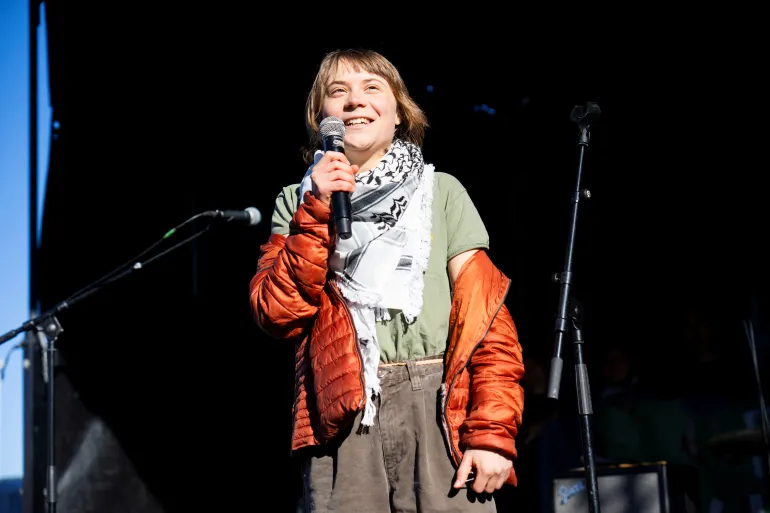
Stockholm, Sweden
In a candid conversation from her apartment in Stockholm, climate activist Greta Thunberg spoke openly about the widening gap between political rhetoric and environmental reality. Speaking with a coalition of international outlets including NBC News, Reuters, and The Nation, she reflected on her viral “blah blah blah” remark, the importance of public pressure, and the need for honesty in tackling the climate crisis.
The Rhetoric of Inaction
During the discussion with Al Roker, Thunberg explained that her widely circulated phrase “blah blah blah” was not an offhand comment, but a deliberate critique of global leadership.
She noted that the phrase was built from actual quotes by world leaders, emphasizing how repeated promises often fail to translate into meaningful action. According to her, such rhetoric creates the illusion of progress while delaying real solutions.
When asked whether leaders are offering more lip service than action, Thunberg responded that the lack of urgency is evident. She argued that no current leadership is treating the climate crisis with the seriousness it demands, adding that even a single country acting decisively could shift the global response.
Climate vs. COVID-19: A Tale of Two Emergencies
Comparing the global response to the COVID-19 pandemic with climate action, Thunberg stated that the difference is clear.
While governments mobilized vast resources and communicated urgency during the pandemic, she believes the same approach has not been applied to climate change. A key issue, she explained, is the lack of public awareness, which stems from leaders failing to present the crisis with honesty and urgency.
Without informed public support, she stressed, meaningful climate action remains difficult to achieve.
The Power of the Individual
Addressing the common belief that individual efforts are insignificant, Thunberg pushed back strongly.
She acknowledged that many activists feel powerless at times, but pointed to the growth of the global climate movement as proof that collective action works. What began as small, localized efforts has evolved into a worldwide network influencing public perception and policy discussions.
According to her, organized movements have the ability to reshape societal norms—and that shift can drive real change.
Expectations for COP26
In her conversation with Anna Ringstrom, Thunberg shared a cautious outlook on the upcoming COP26 summit.
She expressed concern that the event may once again be dominated by polished speeches and vague commitments. For her, true success would mean transparency—openly acknowledging the gap between stated goals and actual performance.
She also criticized the use of “creative accounting” in emissions reporting, arguing that it obscures the real scale of the problem.
Global Inequality and Climate Justice
Thunberg highlighted the imbalance between nations most responsible for emissions and those most affected by climate change.
She described the situation as a betrayal, where less-affected regions fail to support those bearing the greatest burden. This imbalance, she argued, extends beyond future generations, impacting vulnerable populations today.
Addressing this issue requires recognizing historical responsibility and taking meaningful steps toward climate justice.

A Call to the “Grown-Ups”
Thunberg concluded with a message directed at those in positions of influence, particularly the media.
While young activists have led much of the movement, she emphasized that broader societal participation is essential. Media organizations, in particular, have a responsibility to communicate the urgency of the crisis accurately and consistently.
Her message was simple: if you have a platform, use it to reflect reality—and help shift what society considers “normal.”