GPN RESEARCH
Global Markets Intelligence Report
Global Stock Market Indexes
Mid-Month Snapshot • April 13, 2026
Relief Rally Extends as U.S.–Iran Ceasefire Holds; AI Tailwinds Return
KEY INDEX SNAPSHOT
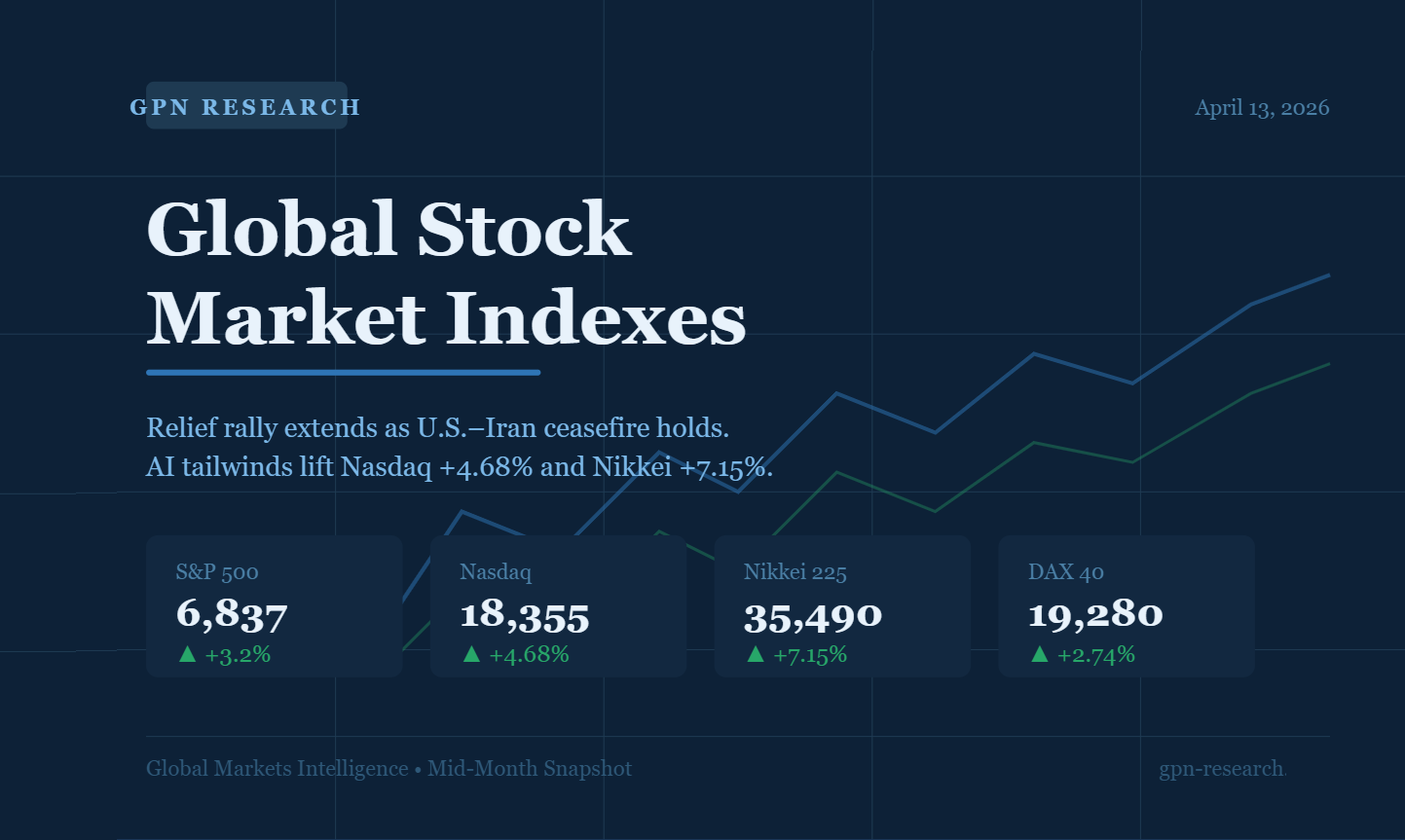
S&P 500 6,837 ▲ +3.2% wk | Nasdaq 18,355 ▲ +4.68% wk | Nikkei 225 35,490 ▲ +7.15% wk | DAX 19,280 ▲ +2.74% wk | |
Executive Summary
Global equity markets extended their recovery into the second week of April 2026, with indexes across all major regions posting strong weekly gains. The primary catalyst was a conditional two-week ceasefire agreement between the United States and Iran, which lifted the geopolitical risk premium that had weighed heavily on sentiment throughout the first quarter. Oil prices declined sharply following the announcement, providing relief to consumer-facing sectors while pressuring energy stocks.
Artificial intelligence-linked equities provided a secondary tailwind, particularly in U.S. and Japanese markets, where large-cap technology and semiconductor names advanced on optimism surrounding compute demand, new model launches, and continued infrastructure spending. Despite the positive near-term momentum, underlying macro conditions remain mixed: U.S. consumer sentiment fell to multi-year lows in April, and the European Union signaled it would revise its 2026 growth forecasts lower in May.
Regional Market Performance
United States
U.S. equity markets recorded solid gains for the second consecutive week, with all three major indexes advancing more than 3% over the period. The Nasdaq Composite led with a gain of 4.68%, driven by renewed strength in mega-cap technology names. The S&P 500 settled near 6,837, while the Dow Jones Industrial Average remained modestly positive.
Within the S&P 500, the energy sector was the sole laggard as oil prices corrected lower. Consumer discretionary, communication services, and information technology led the advance. U.S. Treasuries also posted positive returns for the week, reflecting a modest decline in yields as geopolitical tensions eased.
Index | Region | Level | Weekly Chg. | YTD Chg. |
S&P 500 | USA | 6,837 | +3.2% | -4.1% |
Nasdaq Composite | USA | 18,355 | +4.68% | -8.3% |
Dow Jones (DJIA) | USA | 38,910 | +3.1% | -3.7% |
Russell 2000 | USA | 2,041 | +2.9% | -9.2% |
Europe
European equities staged a broad-based recovery, with the pan-European STOXX Europe 600 Index rising 3.05% in local currency terms. The rally was driven almost entirely by the ceasefire announcement, which reduced energy-price uncertainty and eased concerns about supply chain disruptions.
Italy's FTSE MIB outperformed with a gain of 4.35%, followed by France's CAC 40 at +3.73%, Germany's DAX at +2.74%, and the UK's FTSE 100 at +1.57%. The more modest UK performance partly reflects ongoing divergence in monetary policy expectations and the separate trajectory of UK energy pricing. European markets were also closed for Easter Monday during the week, limiting trading volume on Monday.
The EU Economy Commissioner indicated that the bloc is preparing to revise its official growth forecast for 2026 downward in May, citing the risk of a stagflationary environment characterized by low growth and rising inflation. The Iran conflict, even under a short-lived scenario, is estimated to reduce EU GDP growth by approximately 0.4% this year.
Index | Country | Level | Weekly Chg. | YTD Chg. |
STOXX Europe 600 | Europe | 481 | +3.05% | -6.1% |
DAX 40 | Germany | 19,280 | +2.74% | -5.8% |
CAC 40 | France | 7,420 | +3.73% | -7.2% |
FTSE MIB | Italy | 32,140 | +4.35% | -4.9% |
FTSE 100 | UK | 8,310 | +1.57% | -2.1% |
Asia-Pacific
Japan's equity markets recorded the strongest weekly gains among developed markets globally, with the Nikkei 225 surging 7.15% and the broader TOPIX Index rising 2.60%. The outperformance was concentrated in technology stocks and exporters that had experienced the steepest sell-offs during the period of heightened geopolitical tension. The relief rally was further supported by Prime Minister Takaichi's announcement of an additional release from Japan's state oil reserves beginning next month.
In China, the Shanghai Composite Index reclaimed the psychologically important 4,000 level, ending the period at approximately 4,010. The index's resilience reflects domestic policy support measures and relatively contained exposure to Middle Eastern energy disruption compared to other Asian economies.
Index | Country | Level | Weekly Chg. | YTD Chg. |
Nikkei 225 | Japan | 35,490 | +7.15% | -11.4% |
TOPIX | Japan | 2,560 | +2.60% | -8.7% |
SSE Composite | China | 4,010 | +0.51% | +2.3% |
Hang Seng | Hong Kong | 21,840 | +2.1% | +5.6% |
Kospi | South Korea | 2,445 | +3.8% | -6.9% |
Macro & Market Context
Geopolitical Risk: U.S.–Iran Ceasefire
The most significant development driving markets during the week was the announcement of a conditional two-week ceasefire between the United States and Iran. The agreement, which halted active military operations in the region, immediately reduced the risk premium embedded in both equity markets and oil prices. Brent crude prices, which had surged more than 60% in March alone — their largest monthly gain since 1988 — fell sharply on the news.
Markets adopted a cautious tone despite the relief rally, with investors and analysts emphasizing the fragile and conditional nature of the ceasefire. Risks to energy supply disruption remain elevated, particularly regarding the Strait of Hormuz, which facilitates a significant portion of global seaborne oil exports. Ceasefire negotiations are expected to resume within the two-week window, with outcomes likely to be a key driver of global risk sentiment through the remainder of April.
Consumer Sentiment & Inflation
The University of Michigan's preliminary consumer sentiment index for April came in at 47.6, a decline of 5.7 points from March. The reading was broad-based, with worsening sentiment reported across all demographic cohorts. Inflation expectations for the year ahead jumped to 4.8%, a full percentage point increase from the prior month, reflecting consumer concerns about the energy price shock and its pass-through to broader living costs.
This deterioration in consumer confidence stands in contrast to the equity market rally and represents a divergence that analysts will monitor closely as Q1 earnings season begins. Falling real household purchasing power, if sustained, could weigh on corporate revenue guidance and limit the duration of the current relief rally.
Earnings Season Outlook
April's equity market rebound is set to face its first significant test as Q1 2026 earnings reporting season swings into gear. Market consensus heading into the season anticipates modest year-over-year earnings growth for S&P 500 constituents, with margin pressure from elevated energy costs and input inflation partially offset by continued AI-driven productivity gains in the technology and financial sectors.
Analyst commentary heading into the season has highlighted that the technology sector's recent recovery may be contingent on guidance reaffirmation from major hyperscalers and semiconductor manufacturers. Any indication of capex moderation or demand softness in AI infrastructure could represent a downside risk to the current consensus.
Outlook & Key Risks
Near-Term (2–4 Weeks)
- Ceasefire outcome: Successful extension or escalation will be the dominant driver of oil, FX, and equity markets. A breakdown in negotiations would likely reverse recent gains sharply.
- Q1 earnings season: Corporate guidance, particularly from technology and energy sectors, will be scrutinized for impact of geopolitical disruption and evolving AI demand.
- Inflation data: March CPI and February PCE readings are due; elevated energy prices in Q1 may push readings above consensus, complicating the Federal Reserve's rate path.
- EU growth revision: A formal downgrade to Eurozone GDP forecasts in May could weigh on European equities and the euro.
Structural Themes to Watch
- AI infrastructure investment cycle: Continued divergence between AI leaders and laggards; new model launches and compute demand signals remain key catalysts.
- Energy transition vs. supply security: The Iran conflict has elevated the strategic value of domestic energy production and LNG capacity globally.
- Rotation dynamics: Value, small caps, and dividend stocks continued to attract capital in Q1; whether this rotation persists alongside a recovering growth sector will shape index-level composition.
DISCLAIMER
This report is produced by GPN Research for informational purposes only and is intended for institutional and professional investors. It does not constitute investment advice, a solicitation, or an offer to buy or sell any financial instrument. All data is sourced from publicly available information as of April 13, 2026. Past performance is not indicative of future results. GPN Research does not accept liability for any direct or indirect loss arising from the use of this report.