At a glance
Ukraine has reclaimed 470 square kilometers of territory in early 2026 — its first net gains since 2023 — as Russia's daily rate of advance has collapsed from nearly 15 square kilometers in late 2024 to just 5.5 square kilometers today. Repeated drone strikes on Russia's Baltic oil ports have cut exports by an estimated 40 to 43 percent, forcing Moscow to ban domestic petrol exports through July. Ukraine estimates it has destroyed 45 percent of Russia's missile production capacity, while drone sortie numbers rose 55 percent in March alone. Zelenskyy has also secured drone technology-sharing agreements with Saudi Arabia, the UAE and Qatar, with further Gulf states in discussions.
Battlefield momentum shifts
Ukraine has recorded its most significant battlefield gains in over two years, according to its military leadership and independent assessments. Commander-in-chief Oleksandr Syrskii confirmed that Ukrainian forces have reclaimed 470 square kilometers of occupied territory in the first quarter of 2026 — the country's first net territorial gains since 2023.
The Washington-based Institute for the Study of War (ISW) corroborated the trend, though its conservative mapping methodology put the verified figure at 334 square kilometers. The institute assessed that Russia's daily rate of advance has fallen by two-thirds over the past 18 months — from nearly 15 square kilometers per day in late 2024 to around 5.5 square kilometers per day in early 2026.
President Volodymyr Zelenskyy described the frontline situation as the best it has been in ten months. "The offensive they were planning for March was thwarted by the actions of our armed forces," he said, while warning that Russia would likely intensify assault operations in response.
Drone warfare drives Ukraine's advantage
Ukraine's expanding drone production has been central to its improved performance. Syrskii noted that combat drone sorties increased by nearly 55 percent in March compared to February, and previously stated that first-person-view (FPV) drones now account for 90 percent of Russian casualties.
Defence Minister Mykhailo Fedorov said ammunition purchases for unmanned aerial vehicles in the first three months of 2026 already exceeded half of all such purchases made throughout 2025, and predicted further acceleration. He also confirmed the testing of a new generation of bomber drones capable of penetrating electronic warfare systems and travelling up to 20 kilometers while carrying payloads of tens of kilograms.
Ukraine has also concluded drone technology-sharing agreements with Gulf states. Zelenskyy confirmed deals with Saudi Arabia, the UAE and Qatar, with discussions ongoing with Jordan, Kuwait, Iraq and Bahrain — a sign of growing international interest in Ukraine's battlefield innovations.
Targeting Russia's war finances
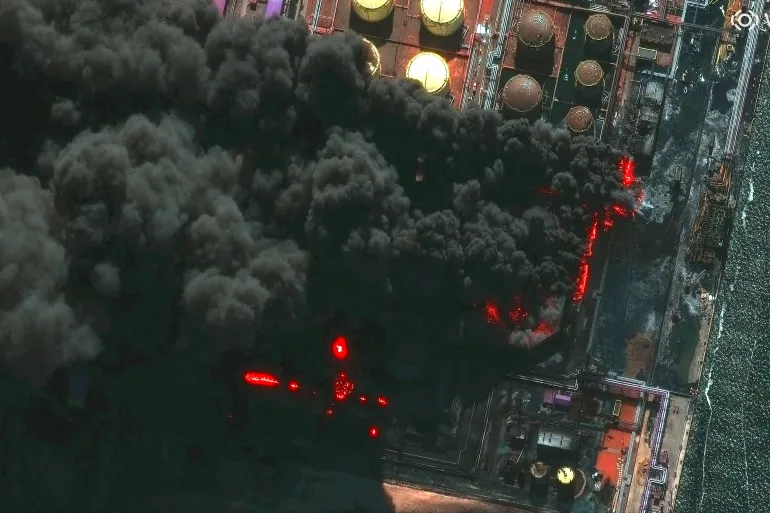
Alongside its battlefield operations, Ukraine has pursued a sustained campaign against Russia's economic infrastructure. Beginning on the night of March 20–21, Ukrainian drones launched repeated strikes on the Baltic Sea ports of Ust-Luga and Primorsk, which together account for approximately 60 percent of Russia's oil export capacity.
By late March, Ust-Luga had been forced to close. Reuters estimated Russia lost around 40 percent of its total oil export capacity as a result, while Bloomberg put the figure at 43 percent — a drop from 4.07 million to 2.32 million barrels per day. Russian oil companies warned buyers they may declare force majeure on supply contracts.
In response, Russian Deputy Prime Minister Alexander Novak drafted a resolution banning refined petrol exports from April through July to stabilize domestic prices — the second such ban in months following similar restrictions in September 2025.
Ukraine also struck the Promsintez explosives plant in Russia's Samara region, which reportedly produces 30,000 tonnes of military explosives annually. Ukraine's Center for Countering Disinformation estimated that Russia has now lost 45 percent of its missile production capacity through cumulative strikes on industrial targets.
Russia and Iran: tactical cross-pollination
Russia has reportedly begun adapting its drone tactics, extending strikes throughout daylight hours rather than limiting attacks to overnight — a change analysts say mirrors Iranian tactics observed in the war against the United States and Israel. On one day in late March, Russia launched nearly 700 drones into Ukraine across day and night sorties; Ukraine intercepted more than 90 percent of them.
The ISW assessed that the extended-hours strategy is intended to impose sustained psychological pressure on the civilian population. There are also reports of tactical knowledge flowing in the other direction — with accounts suggesting Russian military instructors, including personnel linked to the Wagner Group, may be assisting Iran-backed Hezbollah in adopting FPV drone tactics first pioneered by Ukraine.